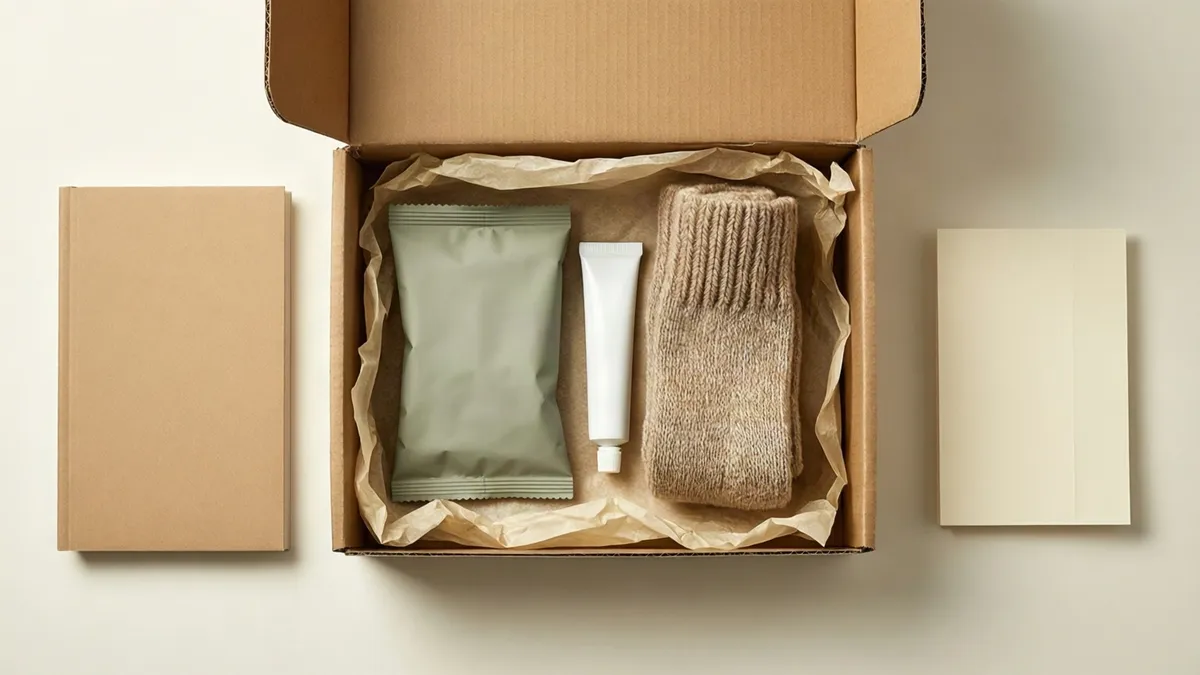
In short: Pack sealed shelf-stable food, soft goods, unscented basics, paper things to do, and one item chosen for this person specifically. Leave out chocolate in warm months, liquid in glass, homemade food, and anything tied with ribbon on the outside of the box. Each of those either fails in transit or hands the recipient a job.
We write packing guides, not lab reviews: we have not tested every product on this page, and nothing here is medical advice. Prices, availability and ratings change constantly — whatever Amazon shows when you click is the authoritative figure.
Most guides to this are a list of things to buy. This one is half a list of things not to buy, and that half does more of the work.
Two facts govern the box. It moves through a system built on the assumption that parcels get dropped, stacked and shaken. It lands in front of somebody whose week is already full.
Everything below follows from those two facts. If you want the definitions and the wider category first, we keep them on what a care package actually is.
The two questions every item has to pass
Ask these in order, and most of the shopping decides itself.
Does it survive the trip? Between your packing tape and their kitchen table, the box rides machinery, sits under heavier parcels, and waits somewhere nobody heats or cools. An item tolerates that or it does not.
Does it create a task? Assembly is a task. So is a decision, a reply, a return label, a plant that needs water, and a container somebody has to wash.
Score every candidate item against both. The rest of this page is that scoring, done out loud.
What travels well
Six categories clear both questions with room to spare. None of them is exciting, which is the point — the box is not a performance.
Sealed, shelf-stable food
Commercially packaged food is the strongest category here, and the reason is regulatory rather than culinary. Under the Federal Food, Drug, and Cosmetic Act as amended by the Food Allergen Labeling and Consumer Protection Act, packaged food has to name any major food allergen it contains.
Writing on October 3, 2024, the National Agricultural Law Center at the University of Arkansas lists those nine: milk, eggs, fish, crustacean shellfish, tree nuts, peanuts, wheat, soybeans, and sesame.
So a sealed bag answers a question you cannot ask without being strange about it.
This article contains affiliate links. If you buy through one, we earn a small commission at no extra cost to you. We only recommend what we would suggest to a friend.
Single-serving formats do best under compression. Browse individually wrapped snack assortments on Amazon, and instant oatmeal cups if the destination has a kettle.
Soft goods
Thick socks, a throw, a knit hat. These do double duty: they are the gift, and they are the cushioning that keeps the rigid things from knocking together.
On its own consumer packing page, the United States Postal Service (USPS) asks for "enough room to add cushioning for fragile items and to prevent items from shifting." Soft goods are how you get that without buying bubble wrap.
Sizing is forgiving in this category, which matters when you are guessing. Look at thick wool crew socks or a fleece throw blanket.
Unscented basics
Lip balm, hand cream, plain tissues. Fragrance-free is the rule, because you do not know the room this gets opened in, who shares it, or what the building's policy is.
An unscented option: fragrance-free lip balm, which is small, cheap and weighs nothing against the flat-rate ceiling.
Paper, and low-effort things to do
Paper survives everything except water. A puzzle book, a paperback, a magazine, a deck of cards — no batteries, no charging cable, no screen, no setup.
Try a large-print crossword puzzle book. If you want them to have an easy way to answer, or to write to somebody else, a letter writing stationery set belongs in the same layer.
One durable object, at most
One hard-goods item gives the box a spine to pack against. Choose one that works one-handed and arrives ready: an insulated water bottle with a straw lid needs no assembly and no instructions.
That is the cap. Two hard items in a small box means one of them is riding on the other.
The item that is only for them
Everything above is generic on purpose. This slot is not.
The regional candy they cannot buy where they are. The crossword from their hometown paper. The specific coffee.
This is the item that proves the box was packed by a person. It is also why the full ideas list sorts by situation instead of by product.
What to leave out
Here is the half nobody writes.
ASTM International maintains a standard, ASTM D4169, for testing shipping containers. Its stated purpose is to evaluate "the ability of shipping units to withstand the distribution environment." That environment is defined as "a sequence of anticipated hazard elements encountered in various distribution cycles."
Read the phrasing again. The industry's own standard treats the trip as a sequence of hazards, and packaging as the answer to it.
Damage is routine enough to be administered. An August 2021 audit report from the USPS Office of Inspector General, on indemnity claim payments, notes that "the Postal Service offers up to $5,000 of insurance coverage." That is protection "against the loss of or damage to a customer's package."
Standing programs exist for things that happen regularly.
No published figure tells you how often parcels are damaged, so we are not going to print one. What follows is what fails, and why.
Chocolate, most of the year
Chocolate is the most common summer mistake in a care package, and it is one of the few items where the failure point is a measured number.
Tempered chocolate owes its snap and gloss to one crystal form of cocoa butter, known as form V. A 2022 paper in the journal Foods on cocoa butter polymorphism identifies six forms by their melting temperatures, and puts form V at 33.8 °C, which is 92.8 °F.
That form, the same paper notes, "is very important for chocolate manufacturers due to it giving the optimal characteristics of gloss, snap, texture, melting, sensation." It is the form in the bar you are buying.
A second measurement, published in Foods in 2021, places the same form across a range of 30.0 to 34.5 °C — roughly 86 to 94 °F.
Call it the low-to-mid nineties Fahrenheit, then. Nothing in the mail stream promises to stay under that.
For scale, take the one enclosed space anybody has published numbers for: a closed vehicle in sun.
According to the National Weather Service, "a dark dashboard or seat can easily reach temperatures in the range of 180 to over 200°F." In one test, it notes, "in just over 2 minutes the car went from a safe temperature to an unsafe temperature of 94.3°F."
Those figures are about cars, not mail trucks, and we are not claiming otherwise. They describe what closed metal in sun does.
There is an argument from the other direction too. The University of Florida IFAS Extension writes about refrigerated truck and rail transport of perishables. Even there, it observes, "the opposite effect occurs during very hot weather and may result in heating and thawing of products along the walls and floor."
Cargo inside a refrigerated trailer can warm at the wall. An unrefrigerated cardboard box gets even less.
Send chocolate in October, February or March. Not July.
Liquid, above a few ounces
Any bottle in a stacked box is a bet on a screw cap. Lose the bet and the shampoo does not just get lost — it soaks the socks, the paperback, the note, and everything else you packed.
Small sealed containers are survivable if each one goes into its own zip bag. Anything larger belongs in a shipment of its own or at their local store, bought with a gift card.
Glass
Glass fails the survival question outright, and it fails it in the worst way. A broken jar turns every other item into something that has to be inspected before it can be touched. No packing technique makes it a good idea.
Buy the plastic version of whatever it is, or pick a different item entirely and put the money there.
Homemade food
Homemade food is genuinely hard to argue against, because it is the warmest thing in the box and the most-recommended item on the internet.
Mailing cookies to a friend is perfectly legal. State cottage food laws — the University of Nebraska–Lincoln's cottage food FAQ, updated 2025, is a good plain-language example — govern selling food, and they mostly stop at state lines. Gifting is not selling. That is not the problem.
The problem is the label, or the absence of one. A commercial package must declare the major food allergens defined in federal law at 21 U.S.C. § 321(qq). Your kitchen declares nothing.
And the line people rely on does less than they think. The National Agricultural Law Center notes that "may contain" advisories "are voluntary statements that may only be used in certain situations." Voluntary means a package without that line has not told you it is free of anything. It has told you nothing.
If you do not know exactly what somebody is eating this month, send sealed and labeled.
Ribbon, string or twine on the outside
Put the bow inside the box. This is not an aesthetic opinion.
USPS states it plainly on its own how-to-send page: "please don't wrap your box in string, cord, or twine, which gets caught in USPS sorting equipment." Anything wound around the outside of a parcel is a hazard to the machine that has to handle it.
Decorate the contents. Close the outside with wide packing tape across every seam, and leave the surface flat and clean.
Anything that needs assembly, a decision or a reply
The second question quietly eliminates a whole shelf of gift-guide favorites.
A build-it-yourself kit is homework. A subscription is a decision they now have to make monthly. A live plant is a dependent. A gift that obviously requires a thank-you note has added an item to somebody's list.
Write "no reply needed" on the card and mean it.
When there is a small child in the house
If the box is going to a household with a toddler, one federal rule is worth knowing. It takes the form of a test you can run on the kitchen counter.
The U.S. Consumer Product Safety Commission's small-parts regulation, 16 CFR 1501.4, specifies a test cylinder for articles intended for children under three. The instruction reads: "Place the article, without compressing it, into the cylinder. If the article fits entirely within the cylinder, in any orientation, it fails to comply."
That test is written for toys sold to that age group, not for the contents of your box. Use the idea anyway.
A small hard item that leaves your box and ends up on the floor of a house with a crawling baby has become somebody else's problem. The CPSC also maintains a public recall database, worth a search before you send anything a child will handle.
If you are sending food anyway
Sealed and labeled beats homemade, but the perishable box is sometimes the right call — a birthday, a holiday, a specific request. Handle it deliberately.
Clemson Cooperative Extension's fact sheet on mailing perishable foods, revised May 8, 2020, gives instructions worth following exactly. Perishables "should be delivered as quickly as possible, ideally overnight." Frozen items should be packed "with a cold source such as frozen gel packs or purchased dry ice."
Label both the food and the outer package "Keep Refrigerated," the fact sheet adds, "to alert the recipient." Then nobody has to guess what just arrived.
Tell them it is coming, and when. A cold box sitting on a porch all afternoon undoes the whole exercise.
One clause matters more than the packing: USPS carries permissible perishable items "at the mailer's own risk." The carrier is not underwriting your soup.
The rules for what may go in the mail at all — the nonmailable list, the restricted list, the flat-rate geometry — live in our main care package guide. Read them before you buy, not after.
Frequently asked questions
What do you put in a care package?
Sealed shelf-stable food, soft goods such as socks or a throw, and unscented basics like lip balm. Then paper things to do, one durable object that works one-handed, and one item chosen for this person specifically. Everything should need no assembly, no refrigeration and no reply. That combination survives the mail and adds nothing to the recipient's week.
What should you not put in a care package?
Chocolate in warm months, liquid in containers over a few ounces, and anything glass. Also homemade food when you do not know the person's diet, and ribbon or twine wound around the outside of the box. Add anything that needs assembly, a subscription decision, a return, or a thank-you note in reply.
Will chocolate survive being mailed?
Season decides that, more than packing does. The crystal form that gives tempered chocolate its snap melts at 33.8 °C, or 92.8 °F, per a 2022 paper in the journal Foods. A 2021 paper in the same journal measures a range of 30.0 to 34.5 °C. Nothing in the mail stream guarantees temperatures below that.
Can you put homemade cookies in a care package?
Legally, yes — cottage food laws govern selling, not gifting. The practical objection is labeling. Federal law requires packaged food to declare the nine major food allergens; your kitchen declares nothing, so the recipient cannot check. If you know their diet precisely, bake. If you are guessing, send something sealed and labeled instead.
Can you tie a ribbon around a care package box?
Not on the outside. USPS asks senders not to "wrap your box in string, cord, or twine, which gets caught in USPS sorting equipment." Put the ribbon on an item inside the box, or use tissue paper and a card. Seal the outside with wide packing tape across every seam and leave the surface clean.
How many things should go in a care package?
Fewer than most guides suggest. Five or six items that each pass both questions beat a dozen that half-pass. A packed box also has a hard ceiling: a flat-rate box is a fixed volume, so the real limit is geometry rather than generosity. Two good consumables and a note is a complete box.
Hannah Ruiz is the care package editor at Care Package Ideas. She is not a clinician, and nothing here is medical advice. How we work is on the about page, her author page has the rest, and our affiliate disclosure explains how the site is funded. Items mentioned here are collected on our products page.
Sources
- Castro-Alayo, Torrejón-Valqui, Medina-Mendoza, Cayo-Colca and Cárdenas-Toro, "Kinetics Crystallization and Polymorphism of Cocoa Butter throughout the Spontaneous Fermentation Process," Foods, June 15, 2022. https://pmc.ncbi.nlm.nih.gov/articles/PMC9222970/ — retrieved 2026-08-20.
- Declerck, Nelis, Danthine, Dewettinck and Van der Meeren, "Characterisation of Fat Crystal Polymorphism in Cocoa Butter by Time-Domain NMR and DSC Deconvolution," Foods, March 2, 2021. https://pmc.ncbi.nlm.nih.gov/articles/PMC7999663/ — retrieved 2026-08-20.
- National Weather Service, National Oceanic and Atmospheric Administration, "Children, Pets and Vehicles," no date shown on page. https://www.weather.gov/safety/heat-children-pets — retrieved 2026-08-20.
- University of Florida Institute of Food and Agricultural Sciences Extension (EDIS), Brecht et al., "Protecting Perishable Foods During Transport by Truck or Rail," no date shown on page. https://ask.ifas.ufl.edu/publication/HS1328 — retrieved 2026-08-20.
- U.S. Government Publishing Office, United States Code, Title 21 § 321(qq), 2023 edition. https://www.govinfo.gov/content/pkg/USCODE-2023-title21/html/USCODE-2023-title21-chap9-subchapII-sec321.htm — retrieved 2026-08-20.
- National Agricultural Law Center, University of Arkansas, "Food Foundations: The Regulation of Food Allergen Labels," October 3, 2024. https://nationalaglawcenter.org/food-labeling-the-regulation-of-food-allergen-labels/ — retrieved 2026-08-20.
- Clemson Cooperative Extension, Home & Garden Information Center, HGIC 3605, "Mailing Perishable Foods," revised May 8, 2020. https://hgic.clemson.edu/factsheet/mailing-perishable-foods/ — retrieved 2026-08-20.
- University of Nebraska–Lincoln, Institute of Agriculture and Natural Resources, "Cottage Food Law FAQ," 2025. https://cottagefoodlaw.unl.edu/faq/ — retrieved 2026-08-20.
- United States Postal Service, "How to Prepare & Send a Package," no date shown on page. https://www.usps.com/ship/packages.htm — retrieved 2026-08-20.
- ASTM International, ASTM D4169-23e1, "Standard Practice for Performance Testing of Shipping Containers and Systems," approval year 2023. https://store.astm.org/d4169-23e01.html — retrieved 2026-08-20.
- United States Postal Service Office of Inspector General, "Manually Adjudicated Indemnity Claim Payments," Report Number 20-129-R21, August 30, 2021. https://www.uspsoig.gov/reports/audit-reports/manually-adjudicated-indemnity-claim-payments — retrieved 2026-08-20.
- Code of Federal Regulations, 16 CFR 1501.4, U.S. Consumer Product Safety Commission, via Cornell Law School Legal Information Institute, no date shown on page. https://www.law.cornell.edu/cfr/text/16/1501.4 — retrieved 2026-08-20.
- United States Postal Service, "Shipping Restrictions & HAZMAT," no date shown on page. https://www.usps.com/ship/shipping-restrictions.htm — retrieved 2026-08-20.