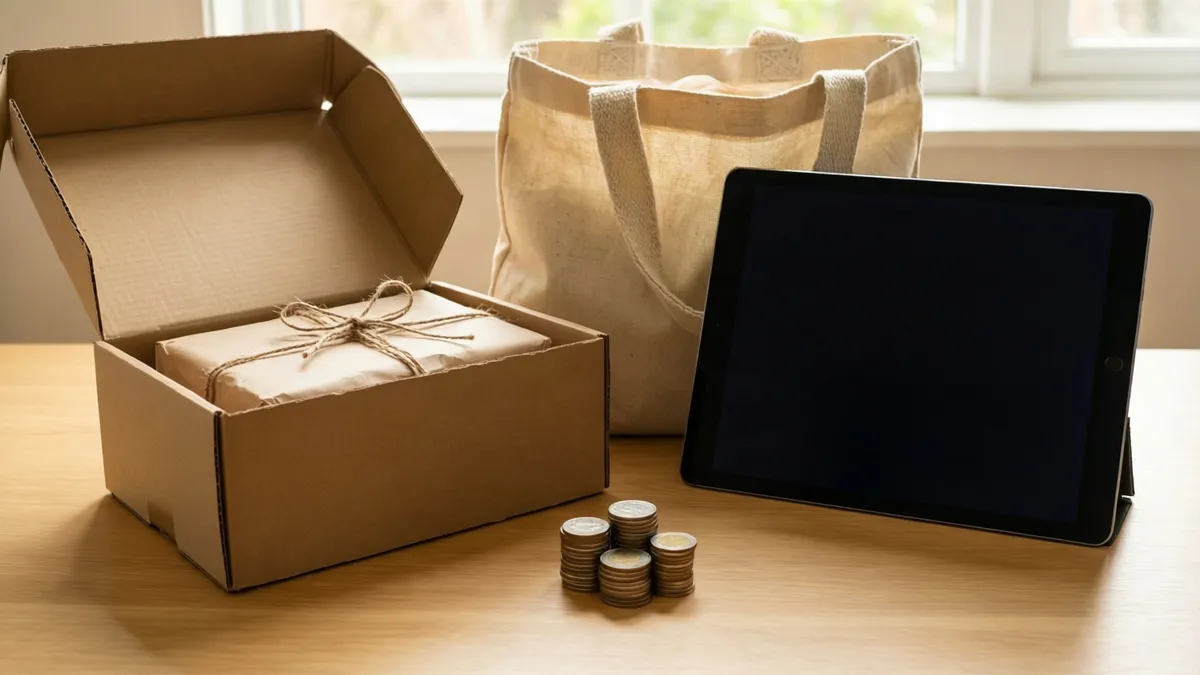
In short: A college care package is a logistics problem, not a love letter. The best items are shelf-stable, one-handed, and small enough to fit in a dorm drawer. Send things that solve a problem your student has already named, and skip anything that needs a fridge, a wall, or a second hand.
We write buying guides, not reviews: we have not used every item on this page, and specs come from the manufacturer or the listing. Whatever Amazon shows when you click is the authoritative figure.
Written by the editorial team behind this site — gift researchers who compile buying guides from public sources, manufacturer specs, and customer reviews rather than hands-on product testing.
A box lands at a campus mailroom counter, waits in a cubby, and gets carried up two flights in one arm. That is the whole life of a care package, and every item has to survive it. The case for sending one is real: the Journal of American College Health reported in 2024 that loneliness prevalence hit 58% in a sample of 84,481 college students. Our Care Package Ideas That Survive the Trip guide covers the shipping side. This page covers the shopping list.
The One Rule: Every Item Needs a Job
One rule sorts the whole list. If an item needs a fridge, a wall, an outlet, or a free hand, it loses. Your student is typing with their thumb, eating on their bed, and storing everything they own in half a dresser. A item that demands more than that becomes laundry-room clutter by October.
There is a reason to send the box at all, and it is worth naming. Psychologists writing in the journal Emotion in 2016 found that 19 to 70% of university students experience homesickness, depending on how it is measured. A package cannot fix that. It can sit on a desk and prove someone is paying attention.
Our suggested test, before anything goes in the cart:
- Does it work without a fridge or an outlet?
- Can they open and use it one-handed, mid-homework?
- Does it fit in a standard dorm drawer?
Three yes answers, it ships. Two, think again. Fewer, and our general guide to what to put in a care package explains where it belongs instead.
Snacks That Survive the Mailroom
Food is the core of the category. In our comparison of 14 ranking guides on this topic, all 14 led with snacks, and the logic holds: food gets used up, which is the whole point.
The survivors share three traits. Sealed, heat-tolerant, and crush-resistant. So:
1. Protein bars. Individually wrapped, no crumbs, fits a backpack pocket. Bulk bars beat a single fancy box.
2. Single-serve chips and crackers. A big bag goes stale the day it opens. Small bags get eaten between classes.
3. Cookies in a sleeve, not a tin. Tins arrive dented and take up shelf space forever.
4. Instant ramen cups. A dorm has a communal microwave; a ramen cup is the cheapest hot meal on campus. A case of cups ships flat and stacks in a drawer.
5. Instant coffee packets. The campus café is a budget problem. Packets are not.
6. Tea bags. Same job, no machine required.
7. Electrolyte drink mix. Flat sachets, weighs nothing, disappears fast.
Skip chocolate from May through September, and skip anything with a melting point you would have to explain.
One-Handed Self-Care That Works Mid-Study
Self-care in a dorm is not a spa day. It is thirty seconds between paragraphs, one hand on the textbook. In our comparison, 9 of the 14 guides covered self-care items; the ones that get used are the ones that need no water, no counter, and no mirror.
8. Lip balm. The classic for a reason. Dorm air is dry and the libraries are worse.
9. Hand lotion, travel size. Winter hallways, constant hand-washing. A small tube lives in a jacket pocket.
10. Sheet masks. One use, no cleanup, and a fun group activity with roommates.
11. Deodorant. Unglamorous, always welcome, never needs explaining.
12. Floss picks. The communal-bathroom test: anything hygiene-adjacent that travels in a pocket wins.
13. A sick-day pouch. Tissues, cough drops, and a basic pain reliever in one zip bag, so nobody walks to the pharmacy with a fever. Check dosing labels against your student's age before you pack any medicine.
Cozy Items That Don't Need a Wall
Comfort items are the second-most-covered category in our comparison: 10 of 14 guides include them. The trap is size. A comforter eats a closet. The winners pack flat and work from a bed.
14. Crew socks. Fuzzy or plain, they vanish at a rate parents find hard to believe.
15. A fleece throw, not a comforter. A throw folds to the size of a textbook and covers a study session.
16. Slippers with rubber soles. Communal bathrooms and hallway tile make these practical, not precious.
17. A hoodie in their actual size. The one clothing item with near-zero risk: wear it or sleep in it.
18. A microwave heat wrap. Thirty seconds in the communal microwave, no plug, no cord, no outlet argument with the roommate.
School Supplies That Get Used, Not Collected
The test for supplies is different: does it replace something they currently borrow? A student who owns the item stops asking the roommate. A student who owns a novelty item owns a novelty item.
19. Gel pens in black and blue. The boring colors are the ones that run out.
20. Highlighters, mild-shade set. Four colors is a system; twelve is a drawer.
21. Sticky notes. The single most borrowed object in a dorm, after chargers.
22. Index cards. Cheap, flat, and still how a lot of studying actually happens.
23. A spare charging cable. Chargers are the number-one dorm dispute. A backup cable ends the argument before it starts.
24. A small power bank. For the day with three back-to-back classes and one outlet in the lecture hall.
Dorm Decor and Organization: The Only Two That Earn Their Space
Most decor fails the thesis. Posters need a wall and permission. String lights need an outlet and often a fire-safety exception. Many housing offices restrict both, and the school's own housing policy is the only one that counts. Two items clear the bar:
25. A lap desk. The bed is the desk, the couch is the desk, the floor is the desk. A lap desk with a wrist edge makes the bed work better, and it stores flat under the mattress.
26. Under-bed storage bins. Dorm rooms run on vertical desperation. Low, lidded bins double the usable floor and need no hardware, no hooks, and no wall.
Care Package Ideas for College Students at $5, $15, and $30
The same idea scales. Across the 14 guides we compared, mentioned prices ran roughly $8 to $30, with a median near $14 — our own computation from those pages, not a sourced figure. The bands below are ours too.
| The idea | $5 version | $15 version | $30 version | The version to skip (our call) |
|---|---|---|---|---|
| Snack drawer | One sleeve of cookies | Six snack bars plus ramen cups | A mixed case that lasts a month | A giant bulk box that needs a shelf |
| Cozy layer | Fuzzy socks | Socks plus a fleece throw | Throw, slippers, and a heat wrap | A full comforter |
| Study kit | Sticky notes and pens | Pens, highlighters, index cards | The kit plus a spare cable and power bank | A desk organizer that needs a desk |
| Sick-day kit | Cough drops and tissues | The pouch plus tea and drink mix | The pouch plus soup cups and a thermometer | A medicine cabinet's worth of doses |
The rest of the list fits any tier. 27. Laundry detergent pods and 28. disinfecting wipes cost a few dollars and save a trip to the store. 29. A handwritten letter with two printed photos costs postage, and it is the item most likely to still exist in a drawer in May. The American College Health Association's National College Health Assessment put loneliness near 50% of the full college population over the last two years. Additionally, a 2023 study in Frontiers in Psychology tied students' relatedness to others to their academic engagement. A letter is not clutter. 30. A gift card to a coffee or grocery chain near campus, described generically because the right one depends on their town. 31. A small card game that fits in a drawer and gets played with roommates.
Our take: Our call is the $15 tier, sent more often, over the $30 box sent once. A mid-size box of snacks, socks, and a note arrives three times a year and keeps the drawer stocked. A single lavish box arrives once, and then the drawer is empty until spring break. Spend up to $30 only for finals week or a birthday, and put the letter in every box regardless of budget.
FAQ: What You Can't Mail and What You Shouldn't Bother With
How much does it cost to ship a care package to a college student?
USPS states that Priority Mail prices start at $11.00 at a Post Office, per its 2026 pricing page. Its Flat Rate products ship up to 70 lbs to any state at one price, which makes a heavy, dense box cheaper to send than the scale would suggest. Check the USPS page before you buy postage; rates move.
How fast does Priority Mail take?
USPS states that Priority Mail includes tracking and delivery in 2 to 3 days. Treat that as the carrier's published range, not a promise, and add buffer before finals week, when every parent in the country is mailing a box at once.
What food gets a care package pulled by the mailroom?
Anything perishable, anything that melts into packaging, and open or repackaged food that can draw pests. Many campuses publish their own restrictions on top of that, so the school's mail services page is the one that counts. Sealed, commercially packaged snacks clear almost every rulebook.
Can I send homemade baked goods?
Yes, with conditions you control. Bake dense, sturdy recipes, wrap each piece separately, and ship early in the week so the box does not sit over a weekend. Skip anything that needs refrigeration, including most cream or custard fillings.
Are subscription boxes better than packing my own?
They solve the effort problem and lose on precision. A subscription sends a fixed assortment whether or not your student likes what is inside; a box you pack answers problems they have actually named. If a subscription keeps you sending anything at all, it is doing its job. Just read the platform's own pricing page for fees before committing.
Hannah Ruiz writes buying guides, not reviews; nothing on this page was tested by us.
Sources
- Journal of American College Health — "Loneliness in the college student population: prevalence and associations with substance use outcomes" (https://pmc.ncbi.nlm.nih.gov/articles/PMC11924129/) "Retrieved 2026-09-15".
- American College Health Association — National College Health Assessment, reported in the same Journal of American College Health article (https://pmc.ncbi.nlm.nih.gov/articles/PMC11924129/) "Retrieved 2026-09-15".
- Emotion — "Homesickness and Adjustment Across the First Year of College: A Longitudinal Study" (https://pmc.ncbi.nlm.nih.gov/articles/PMC5280212/) "Retrieved 2026-09-15".
- Frontiers in Psychology — "Students' academic engagement during COVID-19 times: a mixed-methods study into relatedness and loneliness during the pandemic" (https://www.frontiersin.org/journals/psychology/articles/10.3389/fpsyg.2023.1221003/full) "Retrieved 2026-09-15".
- USPS — "Priority Mail" (https://www.usps.com/ship/priority-mail.htm) "Retrieved 2026-09-15".
- Federal Trade Commission — "Guides Concerning the Use of Endorsements and Testimonials in Advertising" (https://www.ftc.gov/legal-library/browse/federal-register-notices/guides-concerning-use-endorsements-testimonials-advertising) "Retrieved 2026-09-15".